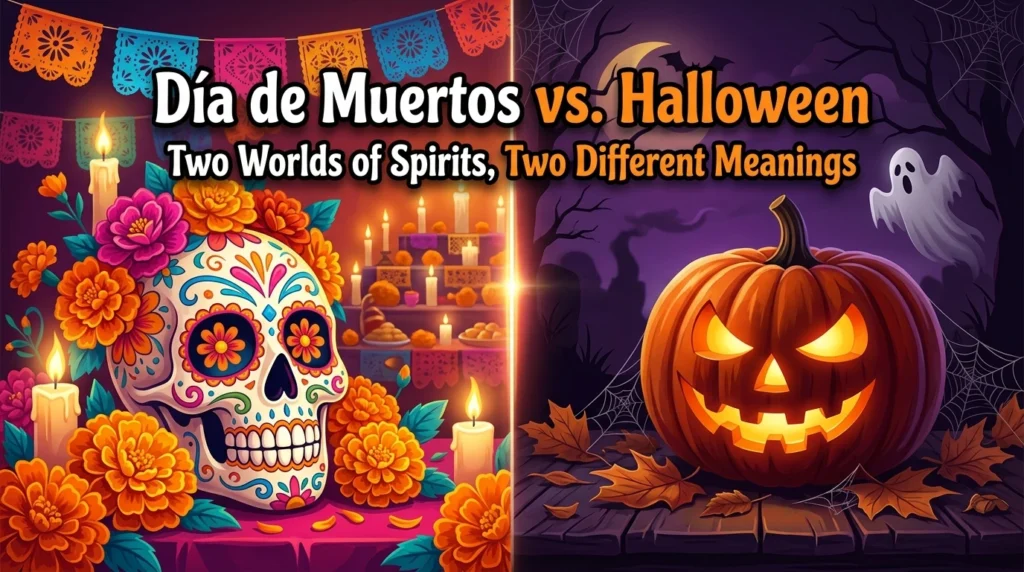
Today, we are going to explore two of the most popular and globally recognized celebrations of the spiritual world: Día de Muertos (Day of the Dead) and Halloween (Noche de Brujas).
Because they happen at the exact same time of year and both involve costumes, sweets, and spirits, many visitors assume they are just different versions of the same holiday. However, as anyone who has experienced the season here in Mexico will tell you, they come from entirely different historical roots and carry vastly different emotional weights.
Let’s break down the origins, the cultural differences, and how they are even beginning to blend in modern times.
What is the Origin of the Day of the Dead?
Unlike many modern holidays, Día de Muertos is not a single event but a profound cultural syncretism—a blending of two entirely different worlds.
Its roots trace back over 3,000 years to Mesoamerican civilizations, including the Aztec, Toltec, and Nahua peoples, who viewed death not as an end, but as a natural phase in the universe’s long continuum. In pre-Hispanic cosmology, mourning the dead was considered disrespectful. Instead, they celebrated the lives of the deceased and believed that during certain times of the year, souls could return to the realm of the living from Mictlán (the underworld).
When the Spanish arrived in the 16th century, they brought Catholic traditions, specifically All Saints’ Day and All Souls’ Day (November 1st and 2nd). Over centuries, the indigenous harvest rituals honoring the dead merged with these Catholic dates. Today, it is a vibrant celebration of memory, centered around the ofrenda (altar)—a space where the living offer water, food, and light to guide their ancestors back home for a brief reunion.
What is the Origin of Halloween?
Halloween’s origins are firmly planted in the damp, misty landscapes of ancient Celtic Europe, specifically Ireland, the UK, and northern France. Over 2,000 years ago, the Celts celebrated a festival called Samhain (pronounced sow-in) on the night of October 31st. This date marked the end of the harvest and the beginning of the dark, cold winter—a time historically associated with human death.
The Celts believed that on the night before the new year, the boundary between the worlds of the living and the dead became blurred, allowing ghosts to return to earth. To ward off roaming spirits, people would light massive sacred bonfires and wear costumes, often consisting of animal heads and skins.
By the 8th century, Pope Gregory III designated November 1 as a time to honor all saints. The evening before became known as All Hallows Eve, and eventually, Halloween. Today’s traditions of trick-or-treating and carving pumpkins are commercialized evolutions of these ancient practices of offering food to spirits and carving scary faces to frighten away evil entities.
Where are they Celebrated?
Halloween is primarily celebrated in the United States, Canada, Ireland, and the United Kingdom. However, due to globalization and pop culture, Halloween parties and trick-or-treating have become popular in many countries worldwide, from Japan to parts of Europe and Latin America.
Día de Muertos is the quintessential Mexican holiday, celebrated throughout the country and by the Mexican diaspora, particularly in the United States. While other Latin American countries have their own Catholic traditions for All Souls’ Day, understanding how the Day of the Dead is celebrated in Mexico reveals a distinctly vibrant set of customs—from the bright cempasúchil flowers to the sugar skulls and elaborate altars.
The Similarities: Blurring the Lines Between Worlds
It is easy to see why the two holidays are often confused. Both take place at the end of October and the beginning of November. Both deal with the concept of the veil between the living and the dead being lifted. Both involve special foods, sweets, and dressing up.
In modern Mexico, we are even seeing a fascinating cultural blend: the “Calaverita” phenomenon. On November 1st, it is now common to see Mexican children dressing up in Halloween costumes (vampires, ghosts, or superheroes) and going to local shops to ask for their calaverita (a small gift of money or candy). It’s a modern fusion of the American trick-or-treat dynamic with the Mexican calendar date.
The Core Differences: Fear vs. Family
The most significant difference between Halloween and Día de Muertos isn’t the geography or the date—it’s the emotion.
Halloween is fundamentally about fear, mischief, and warding off the supernatural. The imagery is designed to be spooky (spiders, bats, haunted houses), and the intention of early costumes was to hide from malevolent spirits.
Día de Muertos is about love, memory, and welcoming family members back home. The imagery is bright, colorful, and joyful. We aren’t hiding from the dead; we are inviting them in to sit at the table with us.
The Local Lens: How We Celebrate in Oaxaca
If you want to truly understand Día de Muertos, you have to look at how it is celebrated regionally. Here in Oaxaca, the holiday takes on an even deeper, more immersive dimension. For those planning a visit, checking out an insider’s guide to Day of the Dead in Oaxaca is the best way to prepare for the experience.
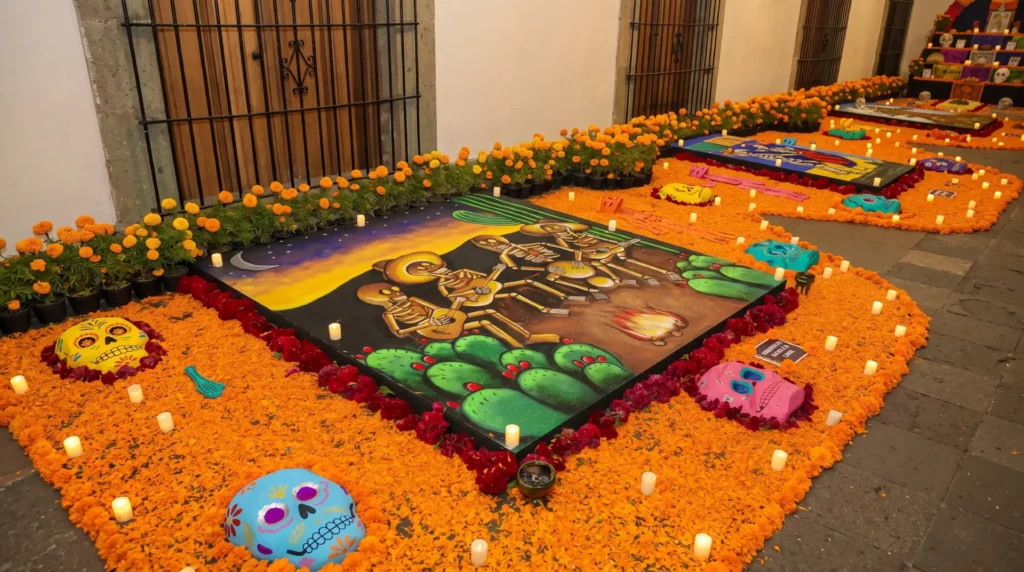
During this season, our streets transform. Beyond the traditional altars, families and artists create intricate tapetes de arena (sand tapestries). These are stunning, temporary artworks made of colored sand, seeds, and flowers laid out on the ground, often depicting religious figures or elaborate skulls.
Then, there is the music and the movement. In neighborhoods and surrounding villages (like the famous celebrations in the Etla valley), we have the muerteadas or comparsas. These are massive, brass-band-led street processions where the entire community dresses up in elaborate, often satirical costumes, dancing through the night to celebrate the return of the spirits. It is a loud, joyful, and deeply communal experience that perfectly encapsulates the Mexican relationship with death—not a terrifying end, but a reason to celebrate the life we shared.